La Fleur
Curated

La Fleur

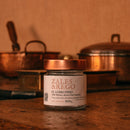
Flor de Sal from an Ancient Inland Salt Spring
€17.90
Drawn from a spring buried under Álava for two hundred million years, not the sea: a flor de sal with a mineral purity no coastal salt can match.
1
Origin Salinas de Añana, Álava (País Vasco), España
Producer Fundación Valle Salado de Añana
Volume 250 g
Appearance

Snow-white pyramid crystals, light, delicate, irregular

Aroma

Faint mineral, no marine iodine signature

Taste · Primary

Pure, distinctive saline character without harshness

Taste · Secondary

Mineral-rich, calcium, magnesium and potassium traces, no kelp or iodine register

Texture

Light, flaky, instant dissolution

Finish

Clean, pure salinity, balanced, sustained

Melaza de Humo
FROM OUR TABLEMelaza de HumoSmoked Chipotle Preserve
El Lomo Fino
FROM OUR TABLEEl Lomo Fino100% Ibérico Acorn-Fed Lomito

Sal de Añana is not sea salt, it is sal de manantial: spring salt. The Valle Salado de Añana, in Álava, is one of the oldest continuously worked salt sites on earth, with unbroken extraction running for more than seven thousand years. 

The brine rises from ancient springs fed by a buried Triassic salt deposit, at several times the salinity of modern seawater. The Fundación channels it by gravity through wooden aqueducts to stone-and-clay evaporation terraces, where sun and wind do the rest: no pumping, no electricity, no marine contact. Salt Valley is the flor de sal expression, delicate pyramid crystals hand-harvested from the surface film. Because the source is fossil rather than marine, the profile is mineral-clean and free of iodine.

The Producer

Fundación Valle Salado de Añana - Álava

The Valle Salado de Añana, in Álava, is one of the oldest continuously worked salt sites on earth, with documented extraction running unbroken for more than seven thousand years. Its brine does not come from the sea: it rises from ancient springs fed by a buried Triassic salt deposit, at several times the salinity of modern seawater. The Fundación channels it by gravity through wooden aqueducts to thousands of stone-and-clay terraces, where sun and wind alone do the work. No pumping, no electricity, no marine contact, just an inland spring and patience.
Region Álava, País Vasco
Source Fossil spring brine, Triassic deposit
Method Gravity-fed, sun-and-wind evaporation
Heritage Worked continuously for 7,000+ years
The Process

Spring water. Stone terraces. Patience.

The brine rises from an underground spring at the head of the valley and is carried by gravity through wooden aqueducts to thousands of small stone-and-clay terraces called eras. There it is left to the sun and wind alone: no pumping, no heat, no machinery. On warm, still days a delicate crust of pyramid-shaped crystals forms on the surface, the flor de sal, and it is skimmed off by hand before it can sink.
Source Underground spring, gravity-fed
Extraction Sun and wind, hand-harvested
Crystal Surface-formed flor de sal
Process No pumping, no heat, no additives

“Some salts come from the sea. Ours comes from a spring that has been waiting since before the sea we know existed.”

Fundación Valle Salado de Añana · Salinas de Añana, Álava (País Vasco), España